AI/ML
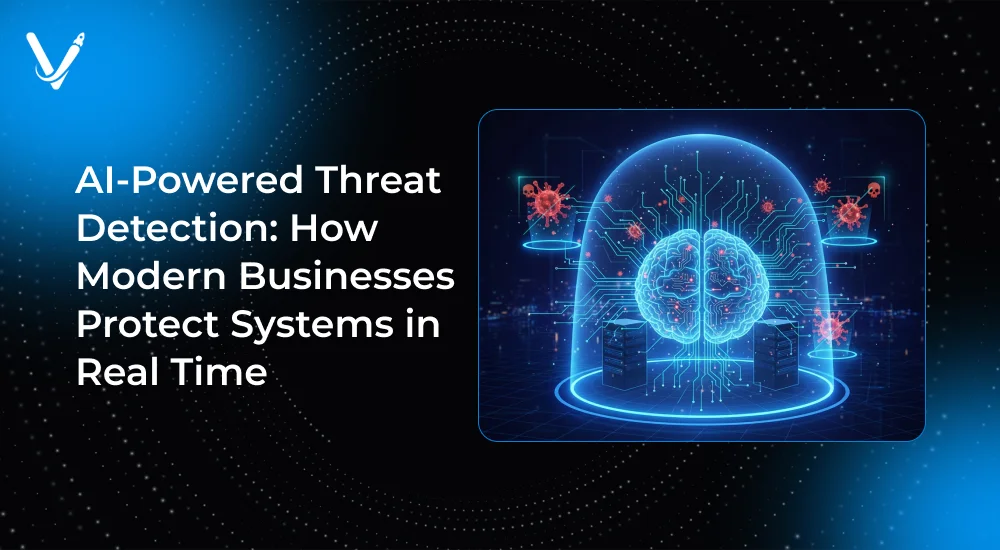
AI-Powered Threat Detection: How Modern Businesses Protect Systems in Real Time

 Dec 1, 2025


Key Takeaways
Every business in today’s digital-first world understands the importance of staying secure. Cyberattacks grow smarter and faster every year, and hackers no longer rely on outdated methods or predictable strategies. They use automated scripts, AI-driven attacks, deepfake tools, and sophisticated malware to breach systems in seconds. Traditional security tools cannot keep up with such evolving threats because they depend on fixed rules, manual monitoring, and delayed alerts.
This is where AI-powered threat detection becomes a transformative solution. AI security systems learn continuously, observe millions of data points, understand patterns, and detect anomalies instantly. They operate like highly trained digital guards who never sleep, never lose focus, and never get tired. As soon as something suspicious appears—an unusual login attempt, abnormal data flow, unexpected server behavior, or a hidden malware signature—AI cybersecurity systems identify it in real time and take immediate action.
This article explores how AI-driven threat detection works, why it's essential, how businesses use it, the technologies behind it, challenges, future trends, and how organizations can adopt AI cybersecurity effectively. The goal is to offer a comprehensive, easy-to-understand guide that helps IT leaders, business owners, developers, and decision-makers strengthen their security posture using AI.
AI-powered threat detection uses artificial intelligence, machine learning, and data analytics to identify cyber risks before they cause damage. Older security systems depend on predetermined rules. If a threat does not match those rules, it goes unnoticed. AI systems, on the other hand, focus on patterns, behaviors, and anomalies.
Instead of reacting to attacks, AI proactively monitors activity, learns continuously, and adapts to new threats.
AI security tools protect business systems by identifying threats across different layers, including:
• Network traffic
• Applications
• User behavior
• APIs
• Cloud infrastructure
• Endpoints such as laptops, mobiles, and IoT devices
• Email and communication systems
• Databases and servers
This multi-layer protection reduces blind spots that attackers often exploit. As a result, businesses stay ahead of security risks, cyber infiltrations, and emerging threats in real time.
Traditional cybersecurity relies heavily on fixed rules, manual monitoring, and signature-based detection. These methods once worked effectively but are no longer enough due to:
Rule-based systems cannot detect new or modified attack patterns. Hackers constantly innovate, making these systems easily bypassed.
Manual review of security alerts leads to delays. Attackers often breach systems and steal data within minutes.
Security teams receive thousands of alerts daily. Many are false positives, causing fatigue and mismanagement.
Traditional tools cannot understand complex behavior patterns or correlate multiple events.
Modern attackers remain hidden inside networks for months, gathering intelligence. These low-and-slow attacks are difficult for traditional systems to identify.
Growing digital operations generate millions of logs, transactions, and connections. Human teams cannot analyze this volume efficiently.
Businesses operate across multiple cloud environments, devices, and software platforms. Traditional systems cannot monitor all endpoints cohesively.
AI eliminates the limitations of these outdated methods by offering intelligent, autonomous, and real-time threat detection.
AI threat detection is a combination of data collection, pattern recognition, behavioral analysis, predictive modeling, and automated response. Instead of relying on pre-defined rules, AI looks for “anything that doesn’t belong.”
Here’s how the process generally works:
AI systems gather and analyze data from various sources every second, including logs, network activity, API calls, user behavior, cloud operations, and device interactions. More data means better accuracy.
Machine learning trains on normal behavior patterns, such as typical user actions or standard system responses. When something deviates from the learned behavior, AI flags it as suspicious.
Modern solutions analyze information from security communities, dark web feeds, malware databases, and global threat networks to predict emerging risks.
AI identifies known malicious patterns including:
• Phishing attempts
• Ransomware signatures
• SQL injections
• Bot traffic
• Brute-force attacks
• Credential stuffing
• Data exfiltration patterns
When AI observes unexpected activities such as data transfers at odd hours or repeated login failures, it classifies them as potential threats.
Each anomaly receives a severity score. High-risk events receive immediate action; low-risk events receive monitoring.
AI security tools take actions like:
• Blocking suspicious IP addresses
• Disconnecting compromised devices
• Terminating harmful sessions
• Isolating affected servers
• Resetting compromised accounts
Every attack attempt teaches the AI system how to be better prepared in the future. This adaptive capability makes AI difficult for attackers to outsmart.
AI threat detection is not a single technology. It includes a collection of intelligent systems working together:
Machine learning algorithms learn normal vs. abnormal patterns across networks, software, and devices.
Deep learning models analyze large datasets including images, logs, and text to detect complex threat patterns like malware signatures or phishing emails.
NLP helps analyze emails, chat messages, and documents to detect phishing attacks, social engineering attempts, or suspicious communication.
UEBA tracks user activity. If an employee suddenly downloads huge data files or accesses restricted areas, the system alerts the admin.
These tools protect individual devices using AI-enabled antivirus, anti-malware, and detection capabilities.
AI identifies unauthorized network access attempts in real time.
Security Information and Event Management systems use AI to unify logs, correlate events, and highlight genuine threats.
Security Orchestration, Automation, and Response platforms automate threat responses instantly.
AI uses global threat data to forecast upcoming risks and prepare defenses proactively.
AI cybersecurity offers powerful advantages that help companies maintain strong security standards while reducing costs and risks.
AI analyzes huge volumes of data instantly. Instead of waiting hours for an alert, businesses get notified in seconds.
AI distinguishes between genuine threats and harmless anomalies. This helps reduce wasted effort and team fatigue.
AI uncovers sophisticated attacks such as:
• Zero-day exploits
• Ransomware mutations
• Insider threats
• Social engineering
• Multi-stage attacks
These threats often go unnoticed by simple security tools.
Automating detection and response reduces the need for large security teams.
AI helps protect:
• Hybrid cloud infrastructure
• Multi-region deployments
• Remote work setups
• IoT devices
• Legacy systems
• DevOps pipelines
AI systems grow with your business. More data, devices, and traffic only make AI smarter and more accurate.
Unlike rule-based systems that require manual updates, AI improves automatically.
Rapid detection shortens dwell time—the period attackers remain unnoticed. Minimizing dwell time saves millions in potential losses.
AI helps organizations align with industry regulations and data protection laws by monitoring suspicious activity continuously.
AI-powered security safeguards businesses against a broad range of digital threats.
AI detects unusual file behavior and encryptions instantly, stopping ransomware before it spreads across the network.
NLP-based email scanning identifies malicious links, attachments, and suspicious sender behavior.
Deep learning models identify malware patterns, even newly created ones.
AI filters out automated bot traffic designed to steal credentials or overload servers.
UEBA systems identify unusual employee actions, preventing data theft and misconduct.
AI recognizes abnormal login patterns indicating compromised accounts.
AI predicts vulnerabilities before hackers exploit them.
AI identifies unusual traffic surges and blocks malicious requests.
API monitoring detects suspicious API calls targeting sensitive data.
Most businesses use cloud platforms, making AI essential for securing cloud systems. AI offers:
AI monitors resource usage, access patterns, and abnormal activities.
Cloud misconfigurations are a leading cause of data breaches. AI alerts the instant it detects risky setups.
AI analyzes login attempts across regions, devices, and apps to stop unauthorized access.
AI monitors data flow and prevents sensitive information from leaving secure environments.
AI scans containers, images, and pipelines to detect vulnerabilities early.
AI tools transform network security through:
AI inspects incoming and outgoing traffic for signs of malware or data exfiltration.
AI blocks unauthorized intrusions automatically.
AI-enhanced firewalls adjust security rules based on real-time behavior patterns.
AI correlates small clues from different network segments to uncover hidden attacks.
Applications face high-volume attacks. AI strengthens app security by:
AI also supports secure CI/CD pipelines by scanning code, dependencies, and artifacts.
AI enables Zero Trust security frameworks, which operate on the principle of “never trust, always verify.”
AI strengthens Zero Trust by offering contextual, real-time decisions instead of static policies.
AI monitors transactions, prevents fraudulent purchases, and stops bot-based attacks.
Banks use AI to protect digital payments, detect account takeovers, and secure customer data.
AI secures electronic health records, regulates access, and prevents data leaks.
AI monitors IoT devices, robots, and smart factories for anomalies.
Cloud-based tools use AI for identity management and API security.
AI identifies network intrusions and maintains uptime.
AI blocks cheating bots, protects user accounts, and prevents server overloads.
AI safeguards customer documents, payments, and communication portals.
AI is a powerful solution, but it also brings challenges:
Poor-quality data results in inaccurate detection.
Although affordable AI tools exist, advanced enterprise systems may require higher investment.
AI security systems require trained professionals for configuration and optimization.
Although rare, AI might miss extremely sophisticated attacks if the dataset is insufficient.
AI must be used responsibly to avoid unnecessary employee monitoring or privacy violations.
Old IT infrastructures may struggle to integrate with AI tools.
Despite these challenges, the benefits far outweigh the limitations when AI is implemented responsibly and strategically.
To make the most of AI cybersecurity, businesses can follow these key principles:
Identify the main areas to protect—applications, cloud, networks, or endpoints.
Clean, well-labeled datasets enhance AI accuracy.
AI handles detection, while security teams oversee decisions and improvements.
AI security platforms should work with current SIEM, SOAR, DevOps, and cloud systems.
Leverage threat intelligence tools to anticipate risks before they occur.
Security models must evolve as new data patterns emerge.
Human errors remain a major cause of breaches. AI helps reduce risk but employees must follow secure practices.
Never assume any user or device is safe automatically.
AI’s role in cybersecurity continues to evolve rapidly. Emerging innovations include:
Networks that automatically repair vulnerabilities.
Systems that set intelligent traps for hackers.
Security centers that operate 24/7 using AI with minimal human input.
AI helps investigate breaches faster and more accurately.
AI platforms share insights across industries in real time to prevent global attacks.
Advanced authentication using typing patterns, mouse movement, facial expressions, or voice signatures.
Preparing AI systems against future quantum-based cyberattacks.
The future leans toward complete automation, predictive security, and ultra-fast threat response.
AI-powered threat detection has become one of the most essential pillars of modern cybersecurity. Businesses operate across cloud platforms, mobile apps, remote teams, IoT devices, and global networks, making traditional security methods insufficient. AI delivers the speed, intelligence, scalability, and adaptability required to protect systems in real time.
By recognizing patterns, analyzing behavior, detecting anomalies, and responding instantly, AI helps organizations stay ahead of cybercriminals. It reduces risk, strengthens compliance, prevents financial damage, and protects digital assets effectively.
Modern businesses that embrace AI-powered security gain a strategic advantage. As cyberattacks continue to grow in sophistication, adopting advanced AI cybersecurity solutions is not just a smart choice—it is necessary.
If you want to build secure applications, protect your business infrastructure, or implement AI-powered threat detection into your digital ecosystem, Vasundhara Infotech can help. Our team specializes in AI-driven security, enterprise solutions, and end-to-end cybersecurity integration tailored to your business needs.
Let us help you create a safer, smarter, and future-ready digital environment.
Copyright © 2026 Vasundhara Infotech. All Rights Reserved.