DevOps & Cloud Hosting
Best Serverless Architecture for Cloud-Based AI Apps in 2026

 Dec 30, 2025



In Article:
Key Takeaways
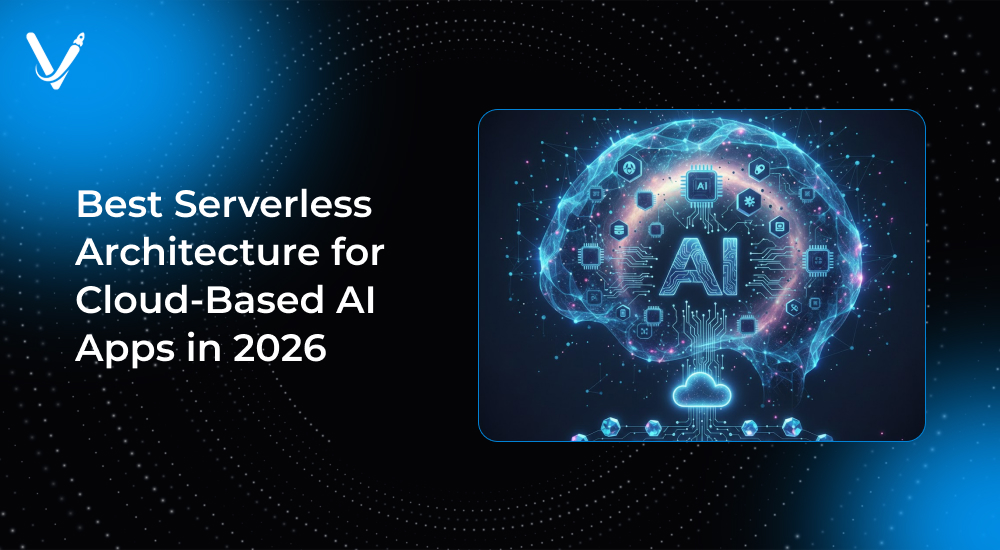
Artificial intelligence continues reshaping how digital products operate, learn, and deliver value. Businesses rely on AI-powered applications for prediction, personalization, automation, fraud detection, analytics, language processing, and intelligent decision-making. As AI adoption grows, infrastructure requirements increase in complexity, scale, and cost. Traditional server-based architectures struggle to meet the dynamic nature of modern AI workloads.
Serverless architecture has emerged as a powerful solution for cloud-based AI applications. It is widely considered the best serverless architecture in cloud environments because it removes the burden of server management, scales automatically based on demand, and allows engineering teams to focus on logic and intelligence rather than infrastructure maintenance. In 2026, serverless design is no longer an experimental choice. It has become a strategic foundation for building resilient, scalable, and cost-efficient AI platforms.
This article explores the best serverless architecture approach for cloud-based AI apps in 2026. It explains architectural principles, core components, cloud service choices, workload patterns, security considerations, performance optimization, and cost control strategies. Decision-makers, architects, and product leaders will gain a clear understanding of how serverless enables intelligent systems that adapt effortlessly to real-world demand.
Serverless architecture refers to an application design model where cloud providers manage infrastructure provisioning, scaling, and maintenance automatically. Developers deploy functions, workflows, or managed services that execute in response to events. Billing aligns with actual usage rather than reserved capacity.
For AI applications, this model offers significant advantages. AI workloads exhibit unpredictable traffic patterns. Inference requests spike during usage peaks. Data processing pipelines run intermittently. Model training tasks consume large resources for short durations. Serverless platforms handle these patterns gracefully without idle infrastructure cost.
Serverless does not imply absence of servers. It implies abstraction of servers away from developer responsibility. Cloud platforms handle capacity planning, fault tolerance, patching, and scaling transparently.
AI workloads demand flexibility, elasticity, and resilience. Serverless architecture naturally aligns with these requirements.
AI inference workloads scale unpredictably. Serverless functions scale instantly to meet request volume. Data pipelines triggered by device events or user actions benefit through event-driven execution. Feature engineering jobs run on demand. Workflow orchestration adapts automatically to system load.
Operational complexity decreases dramatically. Teams avoid server configuration, capacity estimation, and manual scaling. Deployment cycles shorten. Cost optimization improves through pay-per-execution pricing.
In 2025, AI ecosystems integrate deeply with real-time systems, IoT platforms, analytics pipelines, and customer-facing applications. Serverless architecture supports this interconnected environment with agility and reliability.
Designing effective serverless AI systems requires adherence to specific principles.
AI workflows trigger through events such as user requests, data arrival, model updates, or scheduled jobs. Event-driven architecture ensures efficient execution and responsiveness.
Serverless functions execute without relying on local state. Persistent data resides in managed storage systems. Stateless design improves scalability and fault tolerance.
Databases, queues, authentication, storage, analytics, and monitoring rely on managed cloud services. This reduces operational overhead and improves reliability.
Each component scales independently based on demand. Inference functions scale differently compared to data pipelines or orchestration workflows.
Serverless platforms offer built-in fault isolation, retries, and redundancy. AI apps benefit through improved availability and graceful failure handling.
A modern serverless AI architecture consists of multiple integrated layers. Each layer serves a specific purpose and contributes to overall performance and cost efficiency.
AI applications interact with users, devices, and systems through APIs. Serverless API gateways handle request routing, authentication, throttling, and monitoring.
API gateways integrate seamlessly with serverless compute functions. They support REST, GraphQL, and event-based interfaces. Built-in security features protect AI endpoints against abuse and unauthorized access.
Request handling functions perform lightweight validation, preprocessing, and routing logic. They forward requests to inference pipelines or workflow orchestrators.
AI inference represents one of the most critical workloads. Serverless compute executes model inference logic dynamically based on demand.
Lightweight models execute efficiently within serverless function limits. Larger models leverage optimized runtime environments or managed inference services integrated with serverless orchestration.
Key benefits include automatic scaling, cost-efficient execution, and simplified deployment pipelines. Cold start optimization remains important, especially for latency-sensitive AI use cases.
AI systems rarely involve single-step execution. Data ingestion, preprocessing, inference, post-processing, and response delivery often involve multiple steps.
Serverless workflow orchestrators manage complex pipelines. They coordinate execution across functions, handle retries, maintain state transitions, and ensure consistency.
Orchestration enables reliable model deployment, batch processing, retraining workflows, and data validation pipelines without dedicated servers.
AI applications depend on continuous data ingestion. Events arrive via user interactions, devices, logs, or external systems.
Serverless streaming services ingest data at scale. They trigger processing pipelines automatically and support buffering, ordering, and parallel processing.
This design suits real-time analytics, monitoring systems, recommendation engines, and anomaly detection pipelines.
Persistent storage supports model artifacts, feature stores, training data, logs, and inference results.
Serverless AI architectures rely on managed storage services offering high availability and durability. Object storage supports model versioning and dataset management. Managed databases store metadata, user profiles, and configuration.
Feature stores often integrate with serverless compute to provide low-latency access during inference.
AI systems require deep observability to maintain accuracy, performance, and reliability.
Serverless monitoring tools track invocation metrics, latency, error rates, and resource usage. Logs capture inference outcomes and pipeline execution details.
Advanced observability supports model drift detection, anomaly alerts, and system health monitoring without manual infrastructure setup.
Security remains critical in AI systems handling sensitive data and intellectual property.
Serverless security relies on identity-based access control, encrypted communication, secret management, and audit logging. Each function executes with minimal privileges.
Authentication integrates with managed identity services. Authorization policies protect APIs and data stores. Encryption safeguards data at rest and in transit.
Security automation reduces risk exposure and simplifies compliance management.
Cost efficiency represents a major advantage of serverless architecture, yet careless design can still create unnecessary spending.
Small, focused functions execute faster and cost less. Avoid monolithic logic inside single functions.
Minimize payload size and avoid unnecessary data movement. Localize processing close to storage where possible.
Optimize inference code to reduce execution duration. Efficient model loading and caching improve performance.
Use asynchronous patterns for non-critical tasks. This reduces synchronous execution cost and improves responsiveness.
Cache frequent inference results, feature lookups, and configuration data using managed caching services.
Latency plays a crucial role in user-facing AI applications.
Cold starts present a known challenge. Mitigation strategies include runtime optimization, provisioned concurrency, lightweight models, and pre-initialized environments.
Edge execution improves latency for geographically distributed users. Serverless edge computing enables inference closer to users, reducing round-trip delay.
Hybrid patterns combine edge inference with centralized processing for complex tasks.
Major cloud providers offer mature serverless ecosystems suitable for AI workloads.
AWS provides Lambda for compute, API Gateway for request handling, Step Functions for orchestration, S3 for storage, DynamoDB for metadata, and SageMaker integration for AI inference.
This ecosystem suits large-scale AI applications requiring reliability and global reach.
Google Cloud offers Cloud Functions, Cloud Run, Workflows, Pub/Sub, BigQuery, and Vertex AI integration.
Strong data analytics capabilities and AI tooling make it ideal for data-intensive AI applications.
Azure provides Functions, Logic Apps, Event Grid, Cosmos DB, and Azure Machine Learning services.
This stack suits enterprise environments with strong integration across Microsoft ecosystems.
Each platform offers strengths. Architecture selection depends on workload characteristics, team expertise, and ecosystem alignment.
Certain design patterns have proven effective for serverless AI workloads.
Expose AI inference through serverless APIs. Each request triggers model execution and returns predictions.
Stream data into serverless pipelines for real-time analysis and alerting.
Execute large data processing jobs using orchestrated serverless workflows.
Automate training, evaluation, deployment, and monitoring using event-triggered pipelines.
Distribute inference across edge and cloud environments for optimal latency and scalability.
Serverless architecture supports a wide range of AI applications.
Dynamic inference scales automatically during peak usage while remaining cost-efficient during low traffic periods.
Event-driven pipelines analyze transactions in real time and trigger alerts instantly.
Image processing pipelines execute on demand, scaling with upload volume.
Text analysis and conversational AI benefit through asynchronous execution and event-driven workflows.
Serverless pipelines process data streams and deliver insights continuously.
Despite advantages, serverless AI presents challenges that require careful planning.
Cold start latency impacts real-time inference. Execution limits constrain model size. Debugging distributed workflows requires observability tools. Vendor-specific services introduce portability concerns.
Addressing these challenges involves architectural planning, performance testing, and strategic service selection.
Some organizations adopt hybrid or multi-cloud approaches.
Hybrid strategies combine serverless with container-based workloads for large models or long-running tasks.
Multi-cloud approaches reduce vendor dependency and improve resilience. Standardized interfaces and abstraction layers help manage complexity.
These strategies suit organizations with advanced maturity and long-term scalability goals.
Serverless AI continues evolving rapidly.
Edge serverless execution grows in importance. AI accelerators integrate into serverless runtimes. Workflow orchestration becomes more intelligent. Observability tools evolve to support AI-specific metrics.
In 2025 and beyond, serverless architecture will serve as the default foundation for cloud-based AI innovation.
Organizations prioritize speed, flexibility, and cost efficiency. Serverless AI architecture delivers rapid deployment, automatic scaling, reduced operational burden, and strong resilience.
Development teams focus on innovation rather than infrastructure. Businesses respond quickly to market changes. AI solutions scale effortlessly alongside demand.
Vasundhara Infotech designs and delivers scalable serverless architectures tailored for cloud-based AI applications. The team focuses on performance optimization, security, cost efficiency, and long-term maintainability.
Services include AI system architecture, serverless implementation, workflow orchestration, cloud integration, monitoring setup, and continuous optimization. Vasundhara Infotech enables businesses to harness serverless AI with confidence and effectiveness.
Serverless architecture represents a defining shift in how cloud-based AI applications are built and scaled. Its ability to adapt dynamically, reduce cost, and simplify operations makes it ideal for modern intelligent systems.
By adopting event-driven design, managed services, and scalable workflows, businesses unlock powerful AI capabilities without infrastructure burden. The future of AI belongs to architectures that respond intelligently to real-world demand.
Organizations seeking reliable, scalable, and future-ready AI platforms can trust Vasundhara Infotech to deliver expertly designed serverless solutions.
Accelerate your AI journey with a cloud-native foundation built for scale.
Partner with us today.
Copyright © 2026 Vasundhara Infotech LLP. All Rights Reserved.