web development
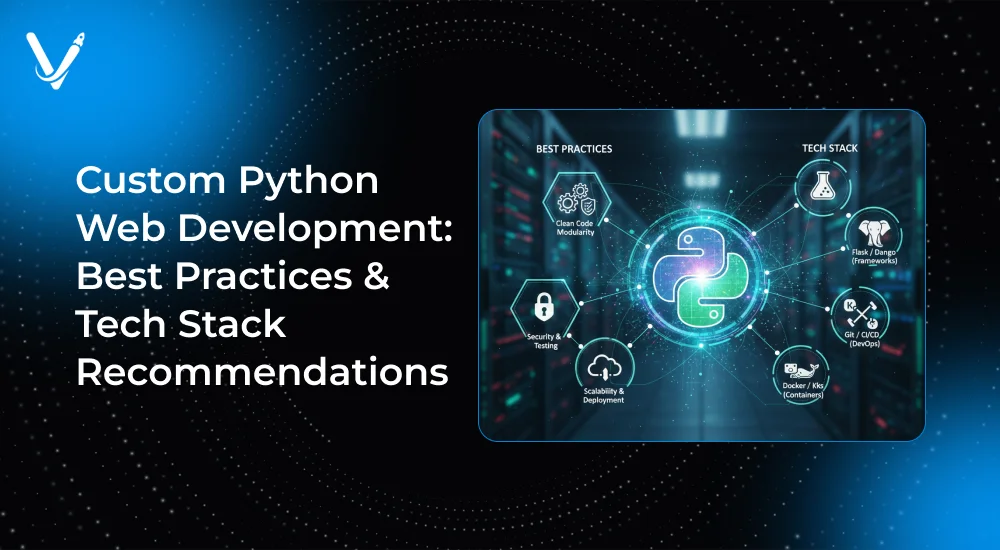
Custom Python Web Development: Best Practices & Tech Stack Recommendations

 Dec 9, 2025


Key Takeaways
In today’s digital landscape, businesses demand web applications that deliver exceptional performance, cross-platform compatibility, long-term flexibility, and seamless integration capabilities. Python has emerged as a trusted choice for building these systems. Known for its elegance, readability, and immense ecosystem of libraries, Python empowers teams to translate ideas into production-ready applications with remarkable speed.
Custom Python web development offers far more than just building websites. It enables businesses to create platforms, automation systems, enterprise portals, AI-powered dashboards, financial tools, e-commerce engines, healthcare platforms, and countless other solutions with precision and efficiency. With an extensive set of frameworks and tools, Python becomes an ideal foundation for small startups and large enterprises alike.
This article explores the core best practices that elevate custom Python web development, along with tech stack recommendations that help teams choose the right tools for reliable, scalable, and future-ready applications. You’ll gain clarity on architecture design, performance optimization, security strategies, database selection, framework comparison, cloud deployment approaches, and modern trends shaping the Python ecosystem.
Python’s popularity isn't accidental. It thrives because it solves real business challenges while offering developers a language that is enjoyable to work with. Several factors contribute to its dominance in the web development space.
Python follows clean, human-friendly syntax, making it easy for new developers to learn and productive for experts to create complex applications quickly. This accelerates development cycles and reduces maintenance cost.
Python has one of the largest communities in the world. Thousands of packages, tools, and frameworks support everything from backend development to data analysis, AI, networking, DevOps, visualization, and more.
Python is not just a web development language. It powers machine learning, automation, IoT, cloud orchestration, fintech solutions, blockchain ecosystems, and scientific applications. This versatility makes integration across systems much smoother.
Enterprises choose Python for its reliability, maintainability, long-term stability, and robustness. Frameworks like Django and FastAPI help build secure, scalable platforms quickly.
Python supports microservices, serverless systems, async processing, distributed queues, containerization, and cloud-native deployments. It integrates effortlessly with AWS, Azure, Google Cloud, Kubernetes, Docker, and modern DevOps pipelines.
Building a successful Python application requires more than simply writing functional code. Having well-defined, professional development practices ensures the platform remains scalable, secure, maintainable, and future-ready.
Below are the essential best practices every Python development team should follow.
A well-designed architecture is the backbone of any robust web application. Clean architecture encourages separation of concerns, modularity, and ease of maintenance.
Key architectural principles include:
Patterns such as layered architecture, hexagonal architecture, domain-driven design (DDD), and microservices architecture suit Python applications particularly well.
Python Enhancement Proposals (PEPs) define standards that maintain consistency and clarity. PEP 8 is the most important guideline for writing readable Python code.
Following these standards:
Linters like Flake8, Black, and Pylint help maintain these standards automatically.
Python offers multiple frameworks suited for different types of web applications. Selecting the right one ensures scalability, security, and faster delivery.
Django is ideal for large, feature-rich applications that require built-in security, admin panels, ORM support, and batteries-included architecture. It fits well for enterprise portals, e-commerce systems, healthcare applications, and fintech platforms.
Flask is a lightweight micro-framework suitable for custom architectures, microservices, experimental projects, prototypes, and applications where developers seek full control.
FastAPI is a modern, async-first framework designed for high-performance APIs. It excels in real-time systems, data-heavy applications, AI integrations, and microservices.
Each framework offers unique advantages depending on performance needs, structure, and complexity.
Security is essential in custom Python web development. Applications often handle sensitive user data, financial records, healthcare information, and private business data.
Security best practices include:
Frameworks like Django include built-in security protections that reduce common vulnerabilities. Flask and FastAPI require additional middleware configuration but can be secured just as effectively.
Performance plays a significant role in user satisfaction and scalability. Python applications must be optimized at every layer.
Key performance principles include:
Monitoring tools such as New Relic, Datadog, and Prometheus help detect performance bottlenecks early.
Databases shape the stability and speed of your application. Python web frameworks typically use ORMs (Object Relational Mappers) to simplify interaction with the database.
Best practices include:
Popular databases for Python include PostgreSQL, MySQL, MariaDB, MongoDB, and Redis.
Testing ensures stability and confidence during deployments. Python offers a rich ecosystem of testing tools.
A strong test strategy includes:
Tools like PyTest, Robot Framework, and Django’s built-in test runner support automated testing pipelines.
Managing dependencies correctly prevents compatibility issues and ensures clean development environments.
Tools like:
help isolate packages and maintain consistent versions across machines.
Continuous integration and continuous deployment pipelines improve velocity, consistency, and quality.
A professional workflow includes:
CI/CD tools ideal for Python include GitHub Actions, GitLab CI, Jenkins, CircleCI, Azure Pipeline, and Bitbucket Pipeline.
Modern applications rely heavily on cloud-native architecture. Containerization ensures consistent execution across development, staging, and production.
Key technologies:
Python-based microservices flourish in containerized environments because they can scale precisely based on traffic.
Any operation that takes long—report generation, email delivery, data processing, video encoding, ML predictions—must run in background workers.
Popular task queues for Python include:
This improves the speed of the API and enhances user experience.
Insights into performance, errors, and user behavior help maintain quality.
Important tools:
Monitoring ensures rapid detection of anomalies and helps maintain uptime across environments.
Now let’s explore the ideal tech stack combinations for building modern, robust Python applications across various use cases.
Advantages:
Django suits projects requiring reliability, large-scale handling, and rapid development cycles.
Advantages:
Flask suits highly customized architectures, lightweight services, and prototypes.
Advantages:
FastAPI suits data-intensive AI platforms, real-time systems, and modern API ecosystems.
Best for transactional systems requiring strict consistency.
Ideal for unstructured data, IoT systems, analytics platforms.
Used for speed enhancement and session management.
Reliable message queues enable distributed task processing.
These tools help scale Python applications across multiple servers.
For applications with search-heavy functionality:
Python integrates seamlessly with these engines for lightning-fast querying.
Python primarily manages backend logic, yet modern applications require powerful frontends.
Recommended stacks:
Frontend integrates easily through REST or GraphQL APIs served by Python frameworks.
Top Python-friendly services:
Strong supports for Python apps:
Enterprise-grade hosting:
Cloud adoption ensures automatic scaling, global load balancing, and advanced monitoring.
Python excels in AI, making it ideal for predictive dashboards, recommendation engines, NLP platforms, and automated systems.
Businesses shift from monoliths to distributed architectures. Python frameworks fit perfectly into scalable microservices.
FastAPI and async frameworks allow real-time chat, live tracking, finance dashboards, and IoT systems.
Modern platforms increasingly rely on API-driven architecture, and Python offers best-in-class frameworks for building robust APIs.
Python powers dynamic backends paired with modern frontend frameworks.
Businesses across industries choose Python because of:
Python remains a strategic asset for fintech companies, healthcare platforms, educational institutions, manufacturing systems, logistics networks, government solutions, and SaaS startups.
Python continues to play an essential role in digital transformation through its simplicity, power, security features, and unmatched ecosystem. With the right best practices, thoughtful architecture, robust testing, skilled team members, and the ideal tech stack, your business can build reliable, scalable, and future-ready applications that stand out in today’s competitive market.
Choosing the right technology partner is critical. Vasundhara Infotech delivers expertise across Python frameworks, cloud-native development, system design, and long-term product evolution. Our team helps businesses build custom web platforms that are secure, scalable, innovative, and perfectly aligned with strategic goals.
Ready to build a world-class Python application?
Partner with Vasundhara Infotech to bring your vision to life with precision and innovation.
Copyright © 2026 Vasundhara Infotech. All Rights Reserved.