SaaS Solutions
How to Plan Custom Software Development — Costs, Strategy & Best Practices (2026)

 Jan 7, 2026



Building custom software requires a methodical approach that balances innovation with risk management, particularly as AI tools reshape traditional development workflows while introducing new governance challenges.
Organizations often partner with experienced enterprise custom software development services to navigate discovery, architecture design, AI governance, and delivery at scale.
Phase 1: Strategic Discovery (3 - 6 Weeks) Conduct a thorough requirement analysis that goes beyond simply creating feature lists. Capture Detailed Business Process Objectives, Customer Personas, Technology Constraints and Regulatory Issues such as EU AI Compliance if selling to European Customers. Complete a Feasibility and Planning Analysis of Technical Architecture and Integration Points with Existing Applications, as well as Preliminary Cost Models.
Phase 2: Technical Architecture Development (2 - 4 weeks) Build out your Overall Technical Architecture based upon Scale and Available Resources of Your Team's Skill Set. For the mid-sized application space, the debate between Modular Monolith and Microservices as far as the architecture design of choice will be that Modular Monolith is going to be preferred based on its definable boundaries per Module while providing an easy way to manage and operate; thus, it is preferred for the majority of the latter Stage(s) (mid-age) applications. Microservices should only be used in true Independent Bounded Contexts where the context has totally different Product Profile(s) and therefore must be scaled separately.
Phase 3: Technology Stack Selection Select frameworks and languages aligned with your team's expertise and long-term maintainability. Consider green software engineering best practices: choose energy-efficient languages (Rust, Go for backend services vs. Python), optimize database queries, implement caching strategies, and design for horizontal scaling only where needed.
| Development Phase | Duration | Key Deliverables | AI Acceleration Impact |
| Discovery & Planning | 3-6 weeks | Requirements docs, wireframes, technical specs | 20-30% faster with AI-assisted documentation |
| Architecture & Design | 2-4 weeks | System architecture, data models, API contracts | 15-25% faster with AI design validation |
| Development (MVP) | 12-20 weeks | Functional core features, testing suite | 30-40% faster with agentic AI code generation |
| Testing & QA | 4-6 weeks | Test coverage, security audit, performance baseline | 25-35% faster with AI-powered testing tools |
| Deployment & Launch | 2-3 weeks | Production environment, monitoring, documentation | 20% faster with AI DevOps automation |
Phase 4: Agile Software Development by AI Tools. Use Iterative Sprints combined with AI-assisted Development. Agentic AI-Based Software Development Tools (e.g. GitHub Copilot, Cursor, or Claude Code) provide automation for writing Tests (Boilerplate) and suggesting optimizations. The distinction is critical; while AI tools enhance the process of Implementation, Software Engineers are responsible for validating the Software Architecture/Code Security and Business logic. You should therefore Budget for one (1) Senior Software Engineer for every Two to Three (2-3) AI-Augmented Developers to keep the Quality of the code in line with company Standards.
Delivering AI-enabled systems at this level typically requires enterprise-grade software architecture design combined with disciplined human oversight.
Phase 5: Building the Cybersecurity Software Requirements for the 2026 Threat Landscape. Start by planning the Implementation of Cybersecurity Software early on in your Development Process. Identify and Implement the Key Elements of a Zero-Trust Architecture, Conducting Threat Modelling Sessions, Integrating Automated Security Scanning (using SAST/DAST), and Preparing your Incident Response Plans before you Launch your Product. The 2026 Threat Landscape will require Security to be both a Key component of any Software Development Lifecycle (SDLC) and part of your core strategy to secure your business.
Phase 6: Iterative Refinement Launch with core features, gather real usage data, and iterate. Modern custom software succeeds through continuous improvement cycles, not big-bang releases.
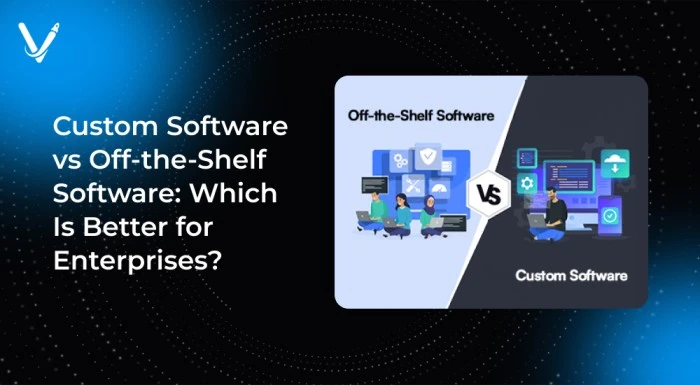
This decision fundamentally impacts operational flexibility, long-term costs, and competitive differentiation. The answer depends on workflow uniqueness, integration requirements, and strategic business value.
When you have unique business processes that are crucial for your competitive advantage, custom software is the best choice. A financial services firm that uses proprietary trading algorithms, a healthcare organization managing multiple patient workflows as per HIPAA regulations or a manufacturer with one of a kind supply chain orchestration needs are all examples of when custom development will deliver the greatest strategic benefit.
Using off-the-shelf (OTS) products may be an appropriate choice when dealing with typical business functions. Generic payroll processing and generic project management systems typically do not provide a significant competitive advantage in a skilled labor market.
Most enterprises adopt hybrid strategies: off-the-shelf SaaS for commodity functions, custom development for differentiating capabilities, and strategic integrations connecting both. This approach optimizes the custom software vs SaaS equation by allocating development resources where they generate maximum business value.
| Evaluation Criteria | Custom Software | Off-the-Shelf SaaS |
| Initial Investment | $100K-$500K+ | $50-$500/user/month |
| Time to Market | 4-9 months | Days to weeks |
| Customization Depth | Unlimited | Limited to platform capabilities |
| Data Control | Full ownership | Shared infrastructure, vendor controls |
| Integration Flexibility | Full ownership | Pre-built connectors, API limitations |
| Long-term TCO (5 years) | Often lower for complex needs | Often lower for standard workflows |
| Maintenance Responsibility | Internal team or partner | Vendor-managed |
| Competitive Differentiation | High potential | Minimal (competitors use same tools) |
Integration Considerations: Whether custom or off-the-shelf, ERP and CRM integration capabilities determine operational success. Custom software provides architectural control but requires intentional integration design. Evaluate API maturity, data synchronization strategies, and whether real-time or batch integration serves your business rhythm.
The AI infrastructure reckoning and global talent market shifts have reshaped cost structures significantly. Organizations now balance traditional development expenses with AI tooling subscriptions, specialized AI Architect salaries, and infrastructure costs for ML model hosting.
Offshore software development rates by country reflect regional expertise, communication efficiency, and quality consistency:
| Region/Country | Hourly Rate Range | AI Adoption Impact | Best For |
| India | $25-50 | High AI tool adoption, rate pressure | Large-scale development, maintenance |
| Eastern Europe (Poland, Ukraine, Romania) | $40-75 | Moderate adoption, quality focus | Complex backend systems, fintech |
| Latin America (Brazil, Argentina, Mexico) | $35-65 | Growing adoption, timezone alignment | US companies needing collaboration overlap |
| Southeast Asia (Vietnam, Philippines) | $20-45 | Emerging adoption | Cost-sensitive projects, mobile development |
| United States | $100-250 | Leading AI implementation | Mission-critical systems, deep integration |
AI Tooling and Infrastructure Costs: Factor $50-150 per developer monthly for AI coding assistants, plus 15-25% increased cloud costs for AI infrastructure. Organizations building AI-native features need dedicated ML infrastructure: GPU compute, vector databases, model hosting, and observability tools add $2,000-10,000 monthly, depending on scale.
A Software Builder creates applications using low-code platforms and AI tools, their salary is between $70,000 - $110,000/year. A Software Engineer designs the system architecture, validates AI-generated code, integrates complex systems and problems and their salary is between $120,000 - $180,000/year. A Software Architect in 2026 will create machine learning systems to design, choose the model and optimize its cost of inference and compliance which may total between $180,000 - $280,000/year.
Small Custom Application (CRM, inventory system): $50,000-150,000 | 3-5 months | 2-3 developers | Basic AI augmentation
Mid-Complexity Platform (eCommerce, booking system): $150,000-350,000 | 5-9 months | 4-6 developers | Moderate AI features, third-party integrations
Enterprise System (Custom ERP, fintech platform): $350,000-$1M+ | 9-18 months | 8-15 developers | Advanced AI, complex integrations, compliance requirements
Integration architecture determines whether your custom software becomes a multiplier of existing investments or creates data silos that fragment operations.
API-First Design: Modern ERPs (SAP S/4HANA, Oracle NetSuite, Microsoft Dynamics 365) and CRMs (Salesforce, HubSpot, Microsoft Dynamics CRM) expose Comprehensive REST or GraphQL APIs. Build your custom software solutions to consume these APIs asynchronously, using Integration Layers that implement Retry Logic, Circuit Breakers, and Rate Limiting to handle Vendor API limitations gracefully.
Event-Driven Integration: For real-time data synchronization, consider implementing Event Streaming Architectures leveraging Message Queues (RabbitMQ, Apache Kafka) or Event Services provided by Cloud Providers (AWS EventBridge, Azure Event Grid). Additionally, as Inventory gets added to your Custom Warehouse Management System (WMS), publish Events that can be Consumed by ERP Systems to ensure Consistency of Data between Systems without Tight Coupling.
Data Synchronization Strategies: Set the frequency of Synchronization based on the Business Need. Financial Data generally requires Real-time Synchronization while Analytic Aggregation can usually be processed during a nightly batch process. In addition, develop Conflict Resolution Methods - use Last-write-wins as a simple process and Custom Merge Logic for Complex Cases.
| Integration Approach | Complexity | Real-time Capability | Maintenance Burden | Best Use Case |
| Direct API Calls | Low | Yes | Medium | Simple CRUD operations |
| Middleware/iPaaS (MuleSoft, Boomi) | Medium | Yes | Low | Multiple system orchestration |
| Event-Driven Architecture | High | Yes | Medium-High | High-volume, decoupled systems |
| Batch ETL | Low | No | Low | Analytics, reporting, bulk operations |
When creating personalized apps with an ERP integrated solution, it’s important to manage your Master Data properly. The ERP system will create the Master Data source (Product Catalogs, Account, Customer and Finance Hierarchy) that is the source of truth for the system (Where will I keep the Data). The custom built solution should consume the Master Data from the ERP and take that Master Data and enhance it to meet the individual Workflow needs, but not create duplicate data.
When integrating a CRM solution, the majority of your focus will be on the customer lifecycle (Lead, Opportunity, Accounts, and customer Interaction) of the customer. There is a need for a bi-directional sync to allow the customer facing custom built app(s) to feed data back into the CRM to ensure a single view of that customer, and to increase Efficiency in both the Sales and Support processes.
Strategic resilience in software engineering means building systems that adapt to 10x growth without architectural rewrites, balancing current simplicity with future flexibility.
Horizontal Scaling First: Design stateless application tiers that scale horizontally behind load balancers. Store session state in distributed caches (Redis, Memcached) or client-side tokens, never in application memory. Database scaling follows: read replicas for query distribution, sharding for write-heavy workloads, and caching layers (CDN for static assets, application caching for computed results) to reduce database load.
Modular Monolith as Growth Foundation: Start with well-organized modular monoliths using clear module boundaries and domain-driven design principles. As specific modules face independent scaling needs—the payment processing module needs PCI compliance isolation, the notification service needs separate rate limits—extract them to independent services. This pragmatic evolution avoids premature microservices complexity while maintaining architectural optionality.
| Scaling Challenge | Solution Pattern | Implementation Complexity | When to Apply |
| Read-heavy load | Read replicas, caching | Low | 70%+ read operations |
Write-heavy load | Database sharding, CQRS | High | Sustained high write throughput |
| Geographic distribution | Multi-region deployment | Medium-High | Global user base, latency requirements |
| Cost optimization | Serverless databases, auto-scaling | Medium | Variable traffic patterns |
When implementing Infrastructure as Code, businesses can automate their infrastructure from the day of set up, which allows them to deploy infrastructure at scale through predictable and repeatable processes. By following the Green Software Engineering Best Practices, companies may also reduce their costs and create less of an environmental impact through deploying resources that have been right sized, as well as allowing their infrastructure to auto-scaled down to meet low demand.
To enable observability when scaling, businesses should set up appropriate instrumentation for their applications via structured logging, distributed traceability, and metric collection. As systems become more complex and require more effort to maintain, what was once considered a "nice to have" is now considered a "need to have". With tools like Datadog, New Relic, or Prometheus and Grafana, businesses may be able to identify and address performance bottlenecks prior to them becoming an outage.
While a technical scale is important to successfully grow the engineer organization, the organization also needs to evolve. The addition of engineers on staff increases the number of lines of communication, resulting in a great deal of overhead for coordinating work and communicating with each other. A modularized approach to architecture is helpful in reducing this cost through defined interfaces between applications.
The custom software vs SaaS debate extends beyond initial cost comparisons to total cost of ownership, operational flexibility, and strategic control over critical business systems.
SaaS Cost Structure: Software as a Service (SaaS) has a seemingly simple pricing model of $50-500 per user per month, but each organization has different experience with use of the platform, along with the number of users, and will continue to grow as they grow their businesses. For example: A 200 employee company that uses SaaS and pays SaaS $100/user/month has an annual total of $240k, over a five year period that amount will climb to $1,200k, plus costs related to migrating or otherwise transitioning to other platforms based on expected SaaS price increases or obsoletions of customer requirements for SaaS pricing model features.
Custom Software Economics: Custom Development estimates for mid-complexity solutions are in the range of $200,000-$400,000 for project-related initialized development costs and also an additional 15-20% annually for project hosting, support, and improvements that requires $30,000-$60,000 annually. After a total of five years of TCO costs associated with custom developed mid-complexity solutions range from $350,000-$600,000, and typically, custom develop solutions reach a return on investment similar to those achieved with SaaS solutions approximately in the 3rd - 4th year of operations.
| Comparison Factor | Custom Software | SaaS Solution |
| 5-Year Total Cost | $350K-600K | $600K-1.5M (200 users) |
| Feature Customization | Unlimited | Limited to the platform |
| Data Portability | Full control, standard formats | Vendor lock-in risks, export limitations |
| Competitive Differentiation | High (unique capabilities) | Low (competitors use the same tools) |
| Update Control | Scheduled, tested | Forced updates, potential disruption |
| Integration Flexibility | Custom-built for needs | Custom-built for needs |
Quantifiable Benefits: Custom software ROI includes productivity gains from optimized workflows, reduced manual work through automation, competitive advantages from unique capabilities, and cost avoidance from eliminating redundant tools. Calculate payback period: if custom software costs $300,000 and saves $100,000 annually in SaaS fees plus 2,000 employee hours ($80,000 value), payback occurs in 20 months.
Strategic Considerations: Some decisions transcend pure financial analysis. Data sovereignty requirements in regulated industries, intellectual property protection for algorithmic competitive advantages, or integration needs with legacy systems may necessitate custom development regardless of SaaS cost competitiveness.
Hybrid Optimization: Leading organizations optimize by function: use SaaS for commodity needs (communication, basic productivity), develop custom software for differentiation (customer-facing applications, unique workflow management), and integrate strategically. This approach maximizes ROI by allocating development investment where it generates competitive advantage.
The regulatory landscape has intensified with EU AI Act enforcement, evolving data privacy laws, and sophisticated cyber threats requiring preemptive cybersecurity approaches embedded in development processes.
Organizations deploying AI-integrated software in Europe face mandatory risk assessments, documentation requirements, and transparency obligations. The Act classifies AI systems by risk level: prohibited (social scoring), high-risk (employment decisions, credit scoring), limited risk (chatbots), and minimal risk (AI-enabled games). High-risk systems require conformity assessments, ongoing monitoring, and human oversight mechanisms.
Implementation Requirements: Establish training data provenance for Document AI; Account for model design decisions; Testing methodologies; and strategies for mitigating bias. Ensure logging is in place to capture explanations of AI decisions—especially for high-risk applications. Companies based in the United States, United Kingdom, Canada and Australia that provide products and/or services to European Union (EU) citizens are required to comply; geographic location does NOT excuse any company from compliance with this regulation when providing goods and/or services to EU citizens.
Security must be integrated into the architecture of a solution, as opposed to being treated as an afterthought in the modern threat landscape. The core concept behind Zero Trust is that a breach will occur; therefore, each request for access must be verified. Implement least privilege access, network segmentation, encryption of data in transit and at rest, and maintain detailed audit logs of user access and activity.
Security Practices for 2026:
Data Protection by Design is a requirement under GDPR, CCPA and new data privacy laws around the world. Implement Data Minimization, Consent Management, Right to Erasure processes and Geographic Data Residency requirements. The development of custom software solutions gives you the architectural flexibility to implement these requirements comprehensively; whereas most SaaS applications are built on shared infrastructure, making it difficult to implement these requirements effectively.
To evaluate a custom software initiative, CTOs and other technology leaders will need to strike a balance between technical excellence and business pragmatism. To accomplish this, begin by setting your direction based on clear business goals, selecting an architectural pattern based on your team’s capability to execute them, and building your security and compliance foundation right from the outset.
You may want to consider partnering with Vasundhara Infotech as they have a deep understanding of your industry vertical and demonstrate a successful history of delivering projects of similar complexity in addition to communicating in a manner consistent with the cultural values of your organization. Whether you are designing a fully custom solution, integrating data from multiple sources or optimizing an existing hybrid architecture, the right approach to developing your software solution will improve your company’s overall ability to compete in the marketplace while also minimizing both technical and financial risk.
The custom software landscape in 2026 rewards organizations that embrace AI augmentation thoughtfully, build architectures supporting sustainable growth, and maintain strategic control over systems differentiating their market position.
Copyright © 2026 Vasundhara Infotech LLP. All Rights Reserved.