business
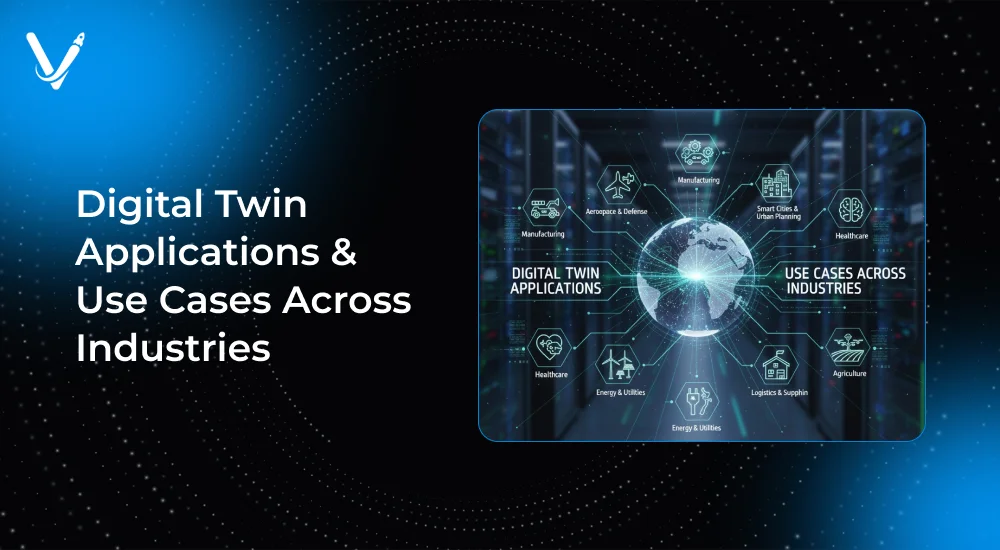
Digital Twin Applications & Use Cases Across Industries

 Dec 31, 2025


Key Takeaways
Imagine being able to see the future behavior of a machine, building, or supply chain before anything actually happens. Imagine making informed decisions, optimizing operations, and predicting failures without risking downtime or compromising safety. This capability is no longer theoretical. It exists today through digital twin technology.
Digital twins represent one of the most impactful advances in digital transformation. They bridge the gap between physical systems and digital intelligence, allowing organizations to observe, simulate, and optimize real-world assets in ways that were previously impossible.
This article provides a deep and practical guide to digital twin applications and use cases across industries. It explains what digital twins are, how they function, the technologies behind them, and how organizations are using them today. It also explores industry-specific implementations, benefits, challenges, and future directions.
This guide is written for business leaders, engineers, product managers, and decision-makers who want a clear and comprehensive understanding of digital twins without unnecessary complexity.
A digital twin is a continuously updated digital representation of a physical object, environment, or system. Unlike traditional models or simulations, a digital twin maintains a live connection with its physical counterpart using real-time or near-real-time data.
This connection allows the digital twin to reflect actual conditions, performance, and behavior. Changes in the physical system automatically update the digital version, enabling accurate monitoring and analysis.
Digital twins can represent a wide range of entities, including machines, vehicles, buildings, manufacturing lines, power grids, and even entire cities. They can also represent non-physical processes such as workflows, logistics operations, or customer journeys.
At its core, a digital twin exists to provide insight, prediction, and optimization.
Modern industries face increasing complexity, rising operational costs, and pressure to improve efficiency while maintaining safety and sustainability. Traditional monitoring and decision-making methods struggle to keep up with these demands.
Digital twins address this challenge by offering continuous visibility and predictive intelligence. Organizations can move from reactive maintenance to proactive strategies, reducing unexpected failures and downtime.
Digital twins also support experimentation without real-world risk. Engineers and planners can test scenarios, evaluate outcomes, and refine strategies before implementation.
This shift enables faster innovation, better resource utilization, and stronger competitive advantage.
Digital twin systems operate through a continuous feedback loop.
Physical assets generate data through sensors, control systems, and software applications. This data is transmitted securely to digital platforms, often hosted in the cloud or at the edge.
The digital twin platform processes incoming data and updates the virtual model. Analytics and AI algorithms analyze patterns, detect anomalies, and predict future behavior.
Insights are presented through dashboards, visual models, or immersive interfaces. Decisions made based on these insights can be applied back to the physical system, completing the loop.
This cycle runs continuously, enabling real-time awareness and adaptive optimization.
Digital twin solutions rely on several interconnected technologies.
IoT devices collect real-time data such as temperature, vibration, pressure, speed, energy usage, and location. This data forms the foundation of digital twin accuracy.
AI analyzes large volumes of sensor and operational data. Machine learning models detect patterns, predict failures, and recommend actions. These models improve continuously as more data becomes available.
Cloud platforms provide scalable storage and processing power. Edge computing enables low-latency processing close to physical assets, which is critical for time-sensitive applications.
Digital twins integrate data from multiple sources including ERP systems, maintenance software, supply chain platforms, and operational databases.
Visualization tools present complex data in intuitive formats. Simulation engines allow users to test scenarios and predict outcomes under different conditions.
Digital twins are classified based on scope and complexity.
These focus on individual parts such as bearings, sensors, or motors. They track health, performance, and degradation.
Asset twins represent complete machines or equipment. They integrate multiple components into a unified model.
System twins model interconnected assets such as production lines, transportation networks, or power grids.
Process twins focus on operational workflows, logistics processes, or business operations.
Enterprise twins integrate multiple systems and departments to provide an organization-wide view of operations.
Manufacturing is a leading adopter of digital twin technology due to its operational complexity.
Digital twins enable manufacturers to monitor machines in real time, optimize production schedules, and reduce downtime. Predictive maintenance models identify early signs of wear or failure, allowing maintenance teams to intervene before breakdowns occur.
Production line digital twins simulate different configurations and workflows. Manufacturers test changes virtually, improving throughput and efficiency without disrupting operations.
Digital twins also support quality management by identifying process variables that affect output consistency.
Healthcare applications of digital twins focus on personalization, efficiency, and safety.
Patient-specific digital twins model individual physiology using medical imaging, vitals, and historical data. Clinicians simulate treatment options and predict outcomes, enabling personalized care.
Hospital digital twins optimize patient flow, staffing, and resource utilization. Administrators reduce bottlenecks and improve service quality.
Medical device digital twins monitor performance and ensure compliance with regulatory standards.
Smart cities use digital twins to manage infrastructure and improve urban living.
City-scale digital twins model transportation systems, buildings, utilities, and public services. Planners simulate development projects, traffic patterns, and environmental impact.
Digital twins enable real-time monitoring of energy consumption, water usage, and waste management.
Emergency response planning improves through simulation of disaster scenarios such as floods, earthquakes, or power outages.
Energy and utility companies rely on digital twins for reliability and sustainability.
Power grid digital twins predict demand fluctuations, optimize load distribution, and prevent outages.
Renewable energy installations such as wind farms and solar plants use digital twins to maximize output and schedule maintenance.
Digital twins support emissions monitoring and sustainability reporting.
Construction projects benefit from digital twins through improved planning and risk reduction.
Building digital twins simulate structural integrity, energy efficiency, and occupant comfort. Construction teams track progress, safety conditions, and equipment usage in real time.
Smart buildings use operational digital twins to manage HVAC systems, lighting, and security.
Property managers optimize maintenance and reduce operating costs.
Transportation systems demand high safety and efficiency.
Automakers use digital twins to simulate vehicle performance, safety tests, and design optimization.
Fleet management systems track vehicle health, fuel efficiency, and route planning.
Railways and aviation systems rely on digital twins for predictive maintenance and scheduling.
Supply chains are dynamic and vulnerable to disruptions.
Digital twins provide end-to-end visibility across suppliers, warehouses, and distribution networks.
Organizations simulate demand changes, shipping delays, and inventory strategies.
Warehouse digital twins optimize layouts, automation, and picking routes.
Agriculture adopts digital twins for precision and sustainability.
Farm digital twins model soil conditions, weather patterns, and crop growth.
Farmers optimize irrigation, fertilization, and harvesting strategies.
Equipment digital twins support predictive maintenance and fuel efficiency.
Digital twins deliver tangible value.
Organizations face several challenges.
Data integration across legacy systems can be complex. High-quality sensor data is essential for accuracy.
Initial investment in infrastructure and skills may be significant.
Cybersecurity and data privacy must be addressed carefully.
Successful adoption requires strategy and discipline.
Digital twins are central to Industry 4.0 initiatives. They enable smart factories, autonomous operations, and intelligent decision-making.
As AI and IoT mature, digital twins will become more autonomous and adaptive.
Future digital twins will incorporate advanced AI agents, edge intelligence, and immersive visualization.
Cognitive digital twins will reason, learn, and act independently within defined boundaries.
Digital twins will play a critical role in sustainability, resilience, and smart infrastructure development.
Digital twin technology is transforming how industries design, operate, and optimize physical and digital systems. By creating real-time virtual replicas, organizations gain deep visibility, predictive intelligence, and control.
Across manufacturing, healthcare, smart cities, energy, construction, transportation, logistics, and agriculture, digital twins enable efficiency, safety, and innovation.
As digital transformation accelerates, digital twins will shift from optional tools to essential operational infrastructure.
Vasundhara Infotech specializes in building scalable digital twin solutions using AI, IoT, cloud, and analytics. If your organization is ready to unlock intelligent operations and future-proof its systems, Vasundhara Infotech is your trusted technology partner.
Copyright © 2026 Vasundhara Infotech. All Rights Reserved.