business
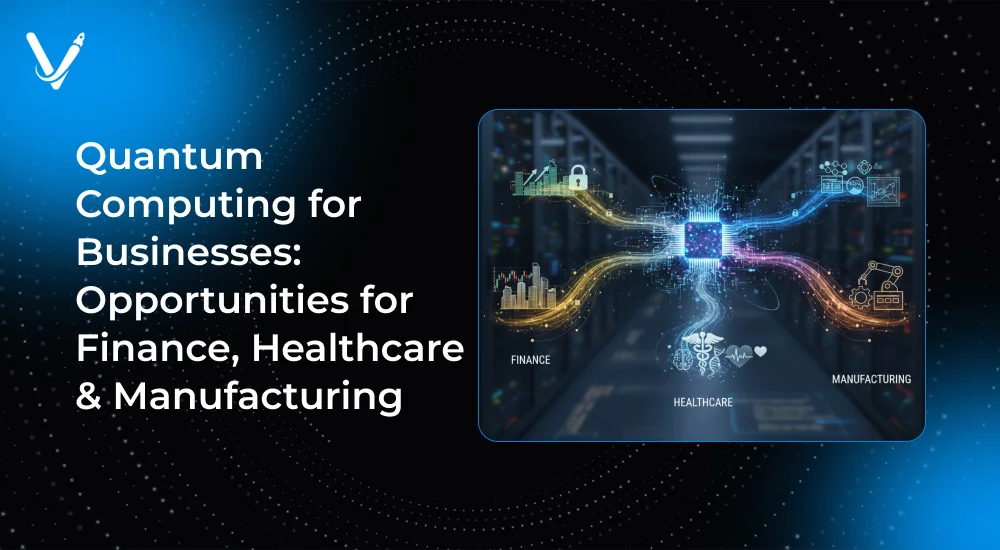
Quantum Computing for Businesses: Opportunities for Finance, Healthcare & Manufacturing

 Dec 8, 2025


Key Takeaways
A new era of computational power is emerging, and businesses across the globe are watching closely. Quantum computing, once considered a distant vision within advanced science laboratories, is now stepping into enterprise strategy discussions. Companies in finance, healthcare, and manufacturing are discovering that quantum systems introduce capabilities no classical machine can reach. These capabilities include simulation at atomic scales, optimization across huge variable sets, predictive precision on complex datasets, and cryptographic transformation built on quantum mechanics.
The business world thrives on innovation that enhances speed, accuracy, and insight. Quantum computing shines in all three dimensions, giving organizations a chance to solve problems that previously required enormous time, storage, or processing strength. Enterprises that embrace this technology early gain strategic advantages in planning, research, product design, diagnostics, logistics, analytics, and operational excellence.
This extensive guide explores how quantum computing empowers finance, healthcare, and manufacturing. It highlights real-world applications, industry challenges, adoption strategies, and the long-term transformation potential this groundbreaking technology carries. By the end of this article, you will understand why a future powered by quantum advantage unlocks unprecedented levels of efficiency, intelligence, and competitiveness.
Quantum computing operates on principles of quantum mechanics, a branch of physics that explores the unique behavior of energy and matter at extremely small scales. Classical computers rely on bits—units representing a value of zero or one. Quantum computers rely on qubits, which can exist as zero, one, or any superposition of both simultaneously. This allows vastly more possibilities to be analyzed at the same moment.
Quantum systems also take advantage of entanglement, a condition where multiple qubits share linked states. Changes to one qubit instantly influence others, even at great distance. This creates pathways for extremely fast operations, parallelism, and deep correlation analysis.
Quantum computing excels in tasks that challenge classical systems, such as:
These strengths create extraordinary value for industries handling large datasets, high-stakes decision-making, scientific research, logistics planning, and multi-factor modeling.
Enterprises operate in environments filled with data complexity, global market pressure, and high expectations for rapid innovation. Traditional systems, even with cloud-scale infrastructure, begin to reach limits when dealing with astronomical datasets or intricate simulation needs. Quantum computing removes many of these limits.
Key drivers for business adoption include:
Classical systems analyze possibilities sequentially or through limited parallel processing. Quantum systems evaluate immense combinations at once across multidimensional states. This acceleration fuels breakthroughs in simulation and optimization tasks that previously required years.
Many industries rely on models to predict risk, behavior, demand, disease progression, chemical reactions, or equipment performance. Quantum algorithms elevate predictive accuracy and drastically reduce computation time.
Quantum systems enable businesses to optimize logistics, supply chains, financial portfolios, production processes, and resource allocation with unmatched precision.
Quantum computing introduces new cryptographic standards and creates demand for quantum-safe security protocols, reshaping how companies protect sensitive information.
Biomedical science, chemistry, material engineering, and energy research gain powerful tools to simulate reactions, analyze molecules, and discover novel compounds.
These advantages position quantum computing as a key driver in the next digital revolution for finance, healthcare, and manufacturing.
Quantum innovation aligns exceptionally well with financial services. Banks, investment firms, insurance companies, and trading platforms all operate within high-stakes environments that rely on accuracy, speed, predictive insight, and risk mitigation. Quantum systems bring remarkable improvements across numerous financial functions.
Risk modeling requires evaluation of vast variable combinations. Classical methods often sample only a portion of possible outcomes, leading to incomplete understanding. Quantum algorithms examine enormous scenario sets in parallel, enabling richer insight into market volatility, liquidity risk, credit risk, and systemic vulnerabilities.
Creating an optimal investment portfolio involves balancing expected return, risk tolerance, diversification strategy, and market dynamics. Quantum techniques evaluate extremely complex parameter sets to produce highly refined portfolio designs tailored to investor preferences.
Quantum-powered pattern discovery strengthens fraud detection by identifying anomalies deeply hidden in transactional streams. Simultaneously, quantum-resistant encryption becomes vital as cyber threats grow more advanced.
Traders rely on rapid decisions informed by subtle market signals. Quantum systems process enormous volumes of real-time data, identify patterns in nanosecond intervals, and enhance algorithmic trading strategies.
Valuation models incorporate uncertainties, non-linear behavior, and interconnected factors. Quantum computing supports highly advanced simulation, leading to more accurate pricing and more resilient financial products.
Quantum algorithms improve analysis involved in compliance audits, stress testing, capital adequacy evaluation, and regulatory reporting by accelerating dataset parsing and reducing human error.
Finance stands positioned as one of the earliest beneficiaries of practical quantum advantage due to its strong dependence on advanced analytics, simulation, and optimization.
Healthcare carries immense responsibility, requiring systems that support accurate diagnosis, fast research cycles, personalized treatment, smart monitoring, and optimized clinical operations. Quantum computing supports breakthroughs across all these areas.
The search for effective therapeutics involves exploring chemical structures, protein interactions, molecular behaviors, and biological pathways. Quantum computers simulate these complex reactions at atomic precision, accelerating drug discovery and reducing development cost.
Pharmaceutical teams gain the ability to:
This revolutionizes how drug portfolios evolve.
Quantum-assisted machine learning enhances image analysis, pattern recognition, and large-scale signal interpretation for diagnostic tools. Medical imaging systems detect anomalies with increased accuracy, improving early intervention and treatment outcomes.
Quantum-supported computation interprets genetic variation at massive scale, enabling personalized treatment plans tailored to an individual’s genetic blueprint. These insights help predict disease risk, drug response, and ideal therapeutic strategies.
Research organizations use quantum algorithms to optimize trial design, match candidates, analyze progression, and predict outcomes. This leads to safer, more efficient trials and faster approval cycles.
Quantum computing enhances hospital logistics. Tasks such as surgery scheduling, patient placement, staff allocation, inventory management, and emergency planning all benefit through improved optimization.
Quantum systems help analysts understand disease transmission, intervention effectiveness, and long-term impact on healthcare resources. These insights enhance policy decisions and crisis response strategies.
Quantum computing brings a new level of intelligence and speed to healthcare, improving patient outcomes, research productivity, and operational efficiency.
Manufacturing relies on precision, automation, quality control, supply chain reliability, and continuous innovation. Quantum computing introduces advanced capabilities that accelerate production and improve decision-making across factories worldwide.
Manufacturers manage global networks filled with logistics partners, vendors, shipping routes, warehouses, and production units. Quantum algorithms optimize these networks through intelligent routing, real-time demand forecasting, and resource balancing.
This leads to:
Quantum-supported models examine enormous sensor datasets collected by machines and equipment. These models identify patterns that indicate potential failure, allowing teams to schedule repairs before breakdowns occur.
Benefits include:
Material engineering advances significantly with quantum simulation. Industrial researchers evaluate atomic structures, thermal behavior, conductivity, and mechanical properties using quantum-supported tools. This accelerates discovery of advanced materials for aerospace, automotive, electronics, energy, and construction.
Quantum-enhanced vision systems interpret extremely detailed images to detect tiny defects. This improves manufacturing accuracy across semiconductor plants, pharmaceutical facilities, automotive lines, and electronics assembly units.
Quantum-based optimization identifies bottlenecks, calculates ideal resource distribution, and enhances workflow sequencing. This helps factories operate at peak efficiency.
Manufacturing plants consume high levels of energy. Quantum algorithms evaluate thousands of energy variables simultaneously, creating optimized usage patterns that lower cost and environmental impact.
Quantum computing strengthens manufacturing through smarter processes, enhanced research, improved sustainability, and greater agility in dynamic markets.
While finance, healthcare, and manufacturing serve as core examples, quantum innovation benefits numerous other industries as well.
Quantum computers introduce new encryption mechanisms that resist attacks even by advanced adversaries. Enterprises upgrade cybersecurity systems through quantum-resistant algorithms, ensuring long-term data protection.
Quantum-supported machine learning enhances pattern recognition, classification, data clustering, and high-dimensional analysis. This leads to smarter AI systems across multiple business sectors.
Urban planners benefit through quantum-assisted modeling for traffic control, utility management, resource planning, and environmental analysis.
Quantum-powered simulation supports climate modeling, carbon cycle analysis, renewable energy optimization, and environmental impact prediction.
Power grids become smarter with quantum optimization that stabilizes load distribution, predicts outages, and integrates renewable energy more effectively.
Quantum computing enriches every sector that handles vast datasets, complex interactions, and large-scale optimization challenges.
As with any emerging technology, quantum computing introduces challenges that organizations must navigate strategically. These challenges include:
Quantum systems remain specialized technology accessible through cloud-based platforms or research partnerships. Direct ownership is rare due to cost, complexity, and environmental stability requirements.
Quantum computing demands knowledge of quantum mechanics, algorithm design, physics, data science, and advanced mathematics. Many businesses lack talent with expertise in this domain.
Current quantum machines deal with instability issues, sometimes known as noise. Specialized error-correction techniques continue to evolve, and hybrid architectures support stability improvements.
Businesses must ensure smooth communication between classical systems and quantum modules. Hybrid quantum-classical workflows require sophisticated architecture planning.
Quantum attacks can break classical encryption. Organizations need to transition toward quantum-safe protocols to protect long-term data assets.
Quantum innovation demands collaboration with experts to determine ideal use cases, build pilots, and evaluate long-term strategy.
These challenges highlight the need for skilled partners, clear strategy, and long-term planning.
Quantum adoption does not require immediate acquisition of complex systems. Many strategic pathways help enterprises begin exploring opportunities safely and effectively.
Organizations must explore areas where quantum advantage creates real impact, such as simulation-heavy tasks, optimization, predictive modeling, and cryptographic protection.
Hybrid quantum-classical systems allow companies to access quantum capabilities through cloud platforms while keeping core processing on classical infrastructure.
Collaborating with quantum technology experts, academic institutions, and specialized development teams accelerates knowledge transfer and reduces risk.
Launching controlled pilots for drug discovery, supply chain optimization, risk analysis, or diagnostics enables teams to validate potential benefits before scaling.
Training initiatives ensure that internal teams learn quantum programming, algorithm design, and practical application development.
Quantum computing evolves rapidly. Continuous research allows organizations to adapt strategies and stay ahead of competitors.
A thoughtful approach helps businesses capitalize on quantum computing without unnecessary complexity.
Quantum computing is still at an early stage, yet its trajectory promises a massive shift in global digital infrastructure. Over the next decade, organizations can expect:
As quantum hardware matures, more industries will experience undeniable acceleration in analytics, simulation, and optimization.
Quantum-assisted algorithms will redefine machine learning, enabling faster training, stronger accuracy, and unparalleled insight across massive datasets.
Biology, chemistry, medical science, energy storage, and environmental research will uncover discoveries powered by quantum simulation.
Legacy encryption will be replaced by quantum-safe protocols, shaping secure communication for government, banking, healthcare, and defense.
Quantum systems will enhance digital twins, IoT networks, predictive maintenance programs, and robotic automation across industrial landscapes.
Organizations that delay exploration risk losing market share to early adopters with stronger prediction, planning, and innovation capabilities.
The future digital economy will rely heavily on quantum innovation.
Quantum computing stands positioned to become one of the most transformative technologies of the century. Its ability to accelerate analysis, optimize complex systems, simulate large models, enhance security, and boost predictive accuracy creates extraordinary opportunities across finance, healthcare, and manufacturing. Early adopters gain the advantage of innovation leadership, operational excellence, and strategic strength.
Organizations that explore quantum computing today build the foundation for a resilient future. Quantum-powered solutions revolutionize risk modeling, drug discovery, material engineering, diagnostics, investment management, supply chain logistics, equipment maintenance, and countless other business processes. The companies that embrace this new horizon will drive tomorrow’s breakthroughs.
If your organization is ready to explore the remarkable potential of quantum computing, Vasundhara Infotech can guide your journey with expert insights, advanced development solutions, and research-driven innovation strategies.
Unlock the future of intelligence, precision, and performance.
Partner with Vasundhara Infotech and bring quantum power to your enterprise.
Copyright © 2026 Vasundhara Infotech. All Rights Reserved.