mobile app development
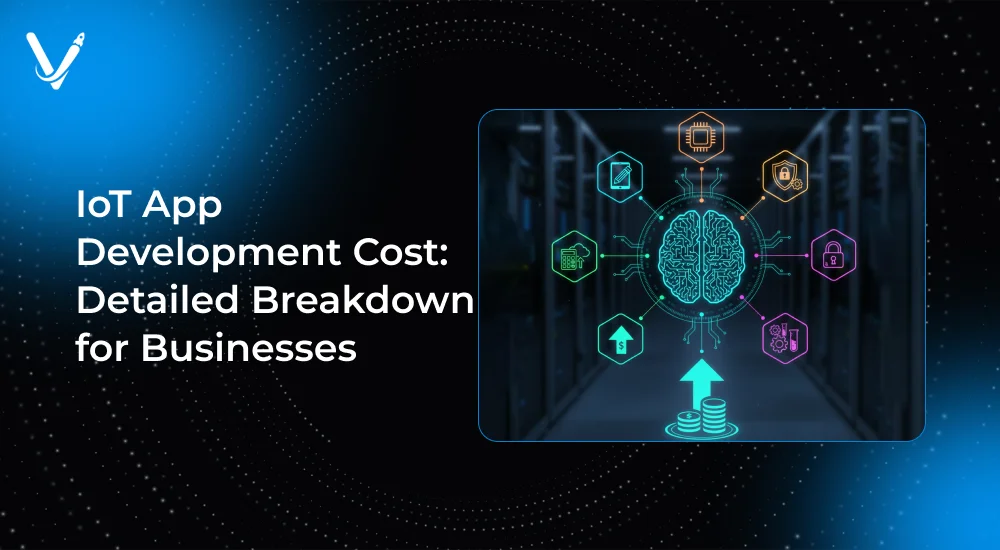
IoT App Development Cost: Detailed Breakdown for Businesses

 Dec 15, 2025


Key Takeaways
The Internet of Things has moved beyond experimentation and entered mainstream business strategy. Organizations across manufacturing, healthcare, logistics, retail, energy, and smart infrastructure invest heavily in connected systems to gain visibility, automation, and data-driven decision-making. Sensors, devices, gateways, and cloud platforms now work together to create intelligent ecosystems that improve efficiency and unlock new revenue opportunities.
Despite growing adoption, one question continues to dominate executive discussions: how much does IoT app development actually cost? Many businesses underestimate the scope involved. An IoT solution extends far beyond a simple mobile application or dashboard. It combines hardware communication, firmware logic, cloud infrastructure, backend services, analytics, security, and long-term operations.
This article provides a deep and practical explanation of IoT app development cost. It breaks down every major cost factor, explains architectural decisions that influence budget, and helps businesses plan realistic investments. By the end, decision-makers will understand how IoT costs form, how to control them, and how to build scalable connected systems without unnecessary spending.
IoT app development refers to building software systems that enable devices to collect data, communicate through networks, process information, and deliver actionable insights to users or systems. These applications typically include device firmware, connectivity layers, cloud infrastructure, backend services, dashboards, mobile apps, and analytics engines.
Unlike traditional software projects, IoT solutions operate across physical and digital environments simultaneously. Devices generate continuous streams of data. Networks transmit this data securely. Cloud platforms store and analyze information. Applications present insights in real time. Each layer adds complexity and cost.
Businesses often adopt IoT to achieve goals such as operational visibility, predictive maintenance, asset tracking, energy optimization, safety monitoring, and automation. The cost of development directly relates to how ambitious these goals are and how mature the expected solution needs to be.
No two IoT projects are identical. Cost differences arise due to variations in use cases, industry regulations, scale, and performance expectations. A simple sensor monitoring application differs greatly compared to a global industrial IoT platform supporting thousands of devices and real-time analytics.
Several underlying factors drive cost variation. Device types differ in capability and firmware complexity. Connectivity options affect data transmission cost and reliability. Backend systems vary in processing requirements. Security expectations change based on data sensitivity. Scalability planning determines long-term infrastructure spending.
Understanding these factors early prevents unrealistic budgeting and costly redesigns later.
IoT app development cost consists of multiple interconnected components. Each component requires technical planning, engineering effort, testing, and maintenance.
The device layer represents the foundation of any IoT solution. It includes sensors, actuators, microcontrollers, and embedded software that enables data capture and communication.
Firmware development cost depends on device complexity, hardware selection, and power constraints. Simple devices that transmit limited sensor values require minimal firmware logic. Advanced devices that perform local processing, encryption, or edge analytics require more sophisticated development.
Testing firmware across different conditions, ensuring power efficiency, and handling device failures also add cost. Firmware updates and remote management capabilities further influence development effort.
Devices require reliable connectivity to transmit data. Network selection affects both development and operational cost.
Common connectivity options include Wi-Fi, cellular networks, LPWAN technologies, Bluetooth, and proprietary industrial protocols. Each option has trade-offs related to bandwidth, latency, power usage, and geographic coverage.
Development cost increases when supporting multiple connectivity options or roaming scenarios. Operational cost includes network usage fees, data plans, and gateway maintenance. Connectivity planning plays a critical role in long-term budget control.
Backend systems form the brain of an IoT solution. They ingest device data, process events, manage device states, and expose APIs for applications.
Cloud infrastructure cost depends on data volume, processing frequency, storage duration, and scalability requirements. Real-time analytics, alerting systems, and machine learning pipelines increase backend complexity.
Businesses often choose cloud platforms due to flexibility and scalability. However, misconfigured infrastructure can lead to unnecessary spending. Efficient architecture design helps balance performance and cost.
IoT solutions generate massive volumes of time-series data. Storing, querying, and analyzing this data represents a significant cost component.
Short-term operational data may require high-speed databases. Historical data storage needs cost-efficient archival solutions. Advanced analytics, predictive modeling, and reporting tools add further complexity.
Analytics cost increases with real-time processing, complex aggregation, and visualization requirements. Businesses must define data retention policies clearly to avoid uncontrolled storage growth.
The application layer includes web dashboards, mobile applications, and user interfaces that display IoT insights.
Application complexity affects development cost. Basic dashboards with charts and alerts cost less compared to feature-rich platforms offering role-based access, reporting, workflow automation, and integration with enterprise systems.
User experience design also influences cost. Applications built for operators, engineers, and executives require different levels of detail and interaction.
Many IoT platforms integrate with existing business systems such as ERP, CRM, asset management, and analytics platforms. Integration complexity varies based on system architecture, data formats, and synchronization frequency.
Custom integrations require API development, data mapping, and testing. Real-time synchronization increases complexity and cost. Integration planning often becomes one of the most underestimated budget elements.
Security represents a critical cost driver in IoT app development. Connected devices expand attack surfaces. Weak security can result in data breaches, operational disruption, or regulatory penalties.
Security measures include device authentication, encrypted communication, secure key management, access control, audit logging, and intrusion detection. Compliance requirements add further cost in regulated industries such as healthcare, energy, and manufacturing.
Investing in security early reduces long-term risk and expensive remediation.
IoT systems require extensive testing across devices, networks, and environments. Testing ensures reliability under varying conditions such as network loss, device failure, power interruption, and high data load.
Quality assurance involves firmware testing, backend stress testing, security testing, and user acceptance testing. Comprehensive testing reduces costly failures after deployment.
Deployment involves device provisioning, cloud configuration, monitoring setup, and application rollout. Maintenance includes bug fixes, performance tuning, firmware updates, and security patches.
Ongoing maintenance cost often exceeds initial development investment over time. Businesses must plan operational budgets realistically to sustain IoT platforms.
While every project differs, general cost patterns emerge based on scope and complexity.
Small IoT projects focus on limited device count, basic monitoring, and simple dashboards. These projects serve proof-of-concept or internal optimization purposes.
Cost remains lower due to minimal integrations, limited analytics, and straightforward architecture. However, skipping scalability planning at this stage can increase future cost.
Mid-scale solutions support hundreds or thousands of devices. They include structured dashboards, alerts, role-based access, and basic integrations.
Cost increases due to backend complexity, security requirements, and analytics capabilities. These solutions often serve commercial deployment and customer-facing use cases.
Enterprise IoT platforms operate across regions and industries. They support large device fleets, real-time analytics, automation, integrations, compliance, and advanced security.
Development cost reflects architectural sophistication and long-term scalability. These platforms require continuous optimization and dedicated operational teams.
IoT app development cost also varies based on industry requirements.
Industrial IoT focuses on equipment monitoring, predictive maintenance, and production optimization. Cost increases due to rugged devices, protocol diversity, edge computing, and integration with legacy systems.
Reliability and uptime expectations also influence budget.
Healthcare IoT solutions manage sensitive patient data and medical devices. Security, compliance, and accuracy requirements significantly increase development and testing cost.
Logistics IoT involves tracking assets across geographies. Connectivity, data accuracy, and real-time alerts influence cost. Integration with fleet management systems adds complexity.
Smart infrastructure projects support large-scale sensor networks and public services. Cost depends on device volume, data analytics, and long-term maintenance planning.
Many IoT budgets fail due to hidden cost elements.
Training and onboarding require investment as teams adapt to new systems. Data governance and compliance management add operational cost. Device replacement and lifecycle management require planning. Customer support infrastructure also contributes to ongoing expense.
Ignoring these aspects leads to underfunded projects and operational strain.
Cost optimization does not mean cutting corners. It means making informed architectural decisions.
Clear business objectives prevent feature bloat. Modular architecture allows phased development. Cloud-native services reduce infrastructure overhead. Reusable components accelerate development. Proper vendor selection ensures predictable pricing.
Partnering with experienced IoT development teams helps avoid costly mistakes and accelerates delivery.
Building IoT systems requires multidisciplinary expertise. Hardware, firmware, cloud, security, analytics, and user experience must align perfectly.
Experienced IoT development companies bring proven architectures, tested workflows, and industry knowledge. They reduce experimentation cost and accelerate time to value.
A trusted partner helps businesses balance innovation with budget discipline.
Vasundhara Infotech delivers scalable IoT solutions tailored to business needs. The team focuses on cost-efficient architecture, secure design, and long-term sustainability.
Services include device integration, backend development, cloud architecture, analytics platforms, application development, and ongoing support. Vasundhara Infotech helps businesses build IoT systems that deliver measurable ROI without unnecessary expenditure.
IoT app development represents a significant investment, yet its value extends far beyond initial cost. A well-designed IoT solution improves efficiency, visibility, automation, and decision-making across operations.
Understanding cost drivers enables businesses to plan realistically, prioritize features, and avoid expensive rework. Strategic architecture, strong security, scalable infrastructure, and expert execution ensure long-term success.
Organizations seeking reliable, scalable, and cost-optimized IoT solutions can rely on Vasundhara Infotech as a trusted technology partner.
Turn connected ideas into profitable reality.
Partner with Vasundhara Infotech for intelligent IoT solutions built to scale.
Copyright © 2026 Vasundhara Infotech. All Rights Reserved.